Zoho Analytics vs Pacten: Which Fits a Small Team?
A dashboard can tell you that revenue dropped.
The harder question is: why?
Which clients stopped buying? Which bookings disappeared? Which invoices are still unpaid? Did a project take longer than expected?
For many small businesses, answering those questions means opening three tabs, checking two spreadsheets and messaging someone who probably knows what happened.
That is where the search for a Zoho Analytics alternative becomes less about finding another dashboard and more about finding software where the numbers are already connected to the work that created them.
If you want deep data modelling, forecasting and business intelligence across multiple sources, Zoho Analytics is a powerful choice. If you want your leads, clients, bookings, projects, invoices and payments connected from the beginning, Pacten takes a different approach.
Zoho Analytics vs Pacten at a glance
Feature | Zoho Analytics | Pacten |
|---|---|---|
Main purpose | Business intelligence and analytics | Connected business management |
Data sources | Connects and analyses data from multiple sources | Business apps work from shared records |
Data modelling | Advanced semantic models and ontology | Connected operational records |
Dashboards and reporting | Extensive analytics and visualisation | Business and operational visibility |
AI analysis | Ask Zia and specialised analytics agents | Pacten AI and AI coordinators |
Forecasting and advanced modelling | Strong | Not designed to replace dedicated BI modelling |
CRM | Connects with CRM data | Built into the workspace |
Bookings | Analyses connected data | Built into the workspace |
Projects and delivery | Analyses connected data | Built into the workspace |
Invoices and payments | Can analyse finance data | Built into the shared client record |
Best for | Teams doing serious analytics across multiple data sources | Businesses that want the work and its records connected from the start |
The short version: Zoho Analytics is stronger when analysing and modelling data is the main job. Pacten is a stronger Zoho Analytics alternative for businesses that want fewer disconnected systems before they ever get to the reporting stage.
See Also:
What Zoho Analytics announced
Zoho Analytics has expanded into what Zoho calls an agentic analytics platform.
The latest release introduces AI agents across the analytics workflow, including agents for analysis, dashboards, data preparation, formulas and SQL. Users can ask questions in natural language and move from preparing data to finding insights and recommendations.
Zoho's new approach centres around four important ideas:
1. Business context
Zoho lets businesses define how their organisation and data fit together through an ontology and semantic layer. You can define business terms, metrics and relationships so AI agents work with a clearer understanding of what the data means.
2. AI agents across analytics
Ask Zia now works across different parts of the analytics workflow, including analysing data, building dashboards, preparing data and generating formulas or SQL.
3. Analytics beyond the dashboard
Zoho Analytics is also pushing its intelligence into other tools through MCP, APIs and integrations, including support for working with AI assistants such as Claude.
4. Governance and control
The platform includes features such as sandbox environments, data policies and AI observability so businesses can test changes, manage access and review AI activity.
Zoho also reports 16,000 customers and 3 million users for its analytics offering, which gives some sense of the scale at which the product operates.
This is serious analytics software.
But that does not automatically make it the right software for every small business.
This is the central question when comparing Pacten with a Zoho Analytics alternative.
Zoho Analytics is built to bring data together, model it and analyse it.
Pacten is built to make sure much of that business activity starts connected in the first place.
In Pacten, a business can manage:
Leads and clients
Bookings and availability
Contracts and documents
Projects and delivery
Tasks and team workloads
Invoices and payments
Communications
People and performance
Stock and suppliers for product businesses
Those apps work from connected records rather than treating every business activity as an isolated entry.
So instead of asking:
Why did revenue change?
You can move directly through the records connected to the answer:
Client → deal → booking → contract → project → invoice → payment.
That difference matters.
Read on:
Where the numbers come from
A business intelligence platform is only as useful as the information available to analyse.
Zoho Analytics solves that by connecting data sources and giving businesses tools to prepare, transform and model the information. Its Data Prep Agent, semantic models and ontology are designed to help teams build reliable analytical context.
Pacten approaches the problem earlier.
The CRM, booking, contract, project and finance tools work inside the same business workspace. A lead does not need to become a completely separate record when it turns into a client. An invoice can remain connected to the work and client behind it.
That makes Pacten a practical Zoho Analytics alternative for owners who are less interested in building an analytics layer and more interested in reducing the number of disconnected records underneath it.
An infographic worth thinking about: one client, one connected journey
A useful way to picture the difference is this:
Disconnected business
Lead → CRM
Booking → Calendar
Project → Project tool
Invoice → Accounting tool
Payment → Payment provider
⬇
Someone has to connect the story afterwards.
Connected business
Lead → Booking → Contract → Project → Invoice → Payment
⬇
The story stays connected as the work happens.
That is not an argument against analytics. It is an argument for giving analytics better foundations.
Learn More:
What questions can you ask?
Imagine a small salon has a slower month than usual.
With a traditional analytics workflow, the owner might ask:
What happened to revenue?
Which service category changed?
Which period performed differently?
Zoho Analytics is designed for this kind of investigation, including descriptive, diagnostic and predictive analysis.
With Pacten, the owner can also start from the operational record:
Which regular clients have not booked again?
Which bookings were cancelled?
Which invoices remain unpaid?
Which services generated the most bookings?
Which client journey changed?
The distinction is subtle but important.
One system specialises in helping you analyse data.
The other keeps more of the business context around the data connected to the work itself.
Where Zoho Analytics is stronger
A fair Zoho Analytics alternative comparison should be honest about this.
Zoho Analytics is the stronger choice when you need:
Advanced data modelling
Zoho provides semantic models, ontology tools and business definitions designed for organisations with complex data relationships.
Deep forecasting and data science
The platform includes forecasting, scenario analysis, correlation tools, anomaly detection, AutoML and support for custom machine-learning workflows.
Multiple external data sources
If your organisation already has data scattered across several systems and needs one dedicated analytical layer over all of them, Zoho Analytics is built for that job.
Specialist analytics work
Its SQL, formula, data preparation and coding capabilities give analysts and technical teams considerably more depth than a general business-management platform is trying to provide.
Pacten should not be chosen because you expect it to replace a dedicated business intelligence platform for advanced data science.
That is not the job it is designed to do.
Where Pacten is stronger
Pacten makes more sense when the problem begins before the dashboard.
One connected workspace
Pacten brings clients, bookings, contracts, invoices, projects, team information and stock into one workspace.
The record follows the work
Instead of repeatedly connecting copies of information, the business can work from records that remain linked as activity moves from selling to delivering to getting paid.
Less system switching
For a small team, the problem is often not a lack of dashboards.
It is:
“Where did we put that information?”
Pacten is designed to reduce that question.
AI inside the business workflow
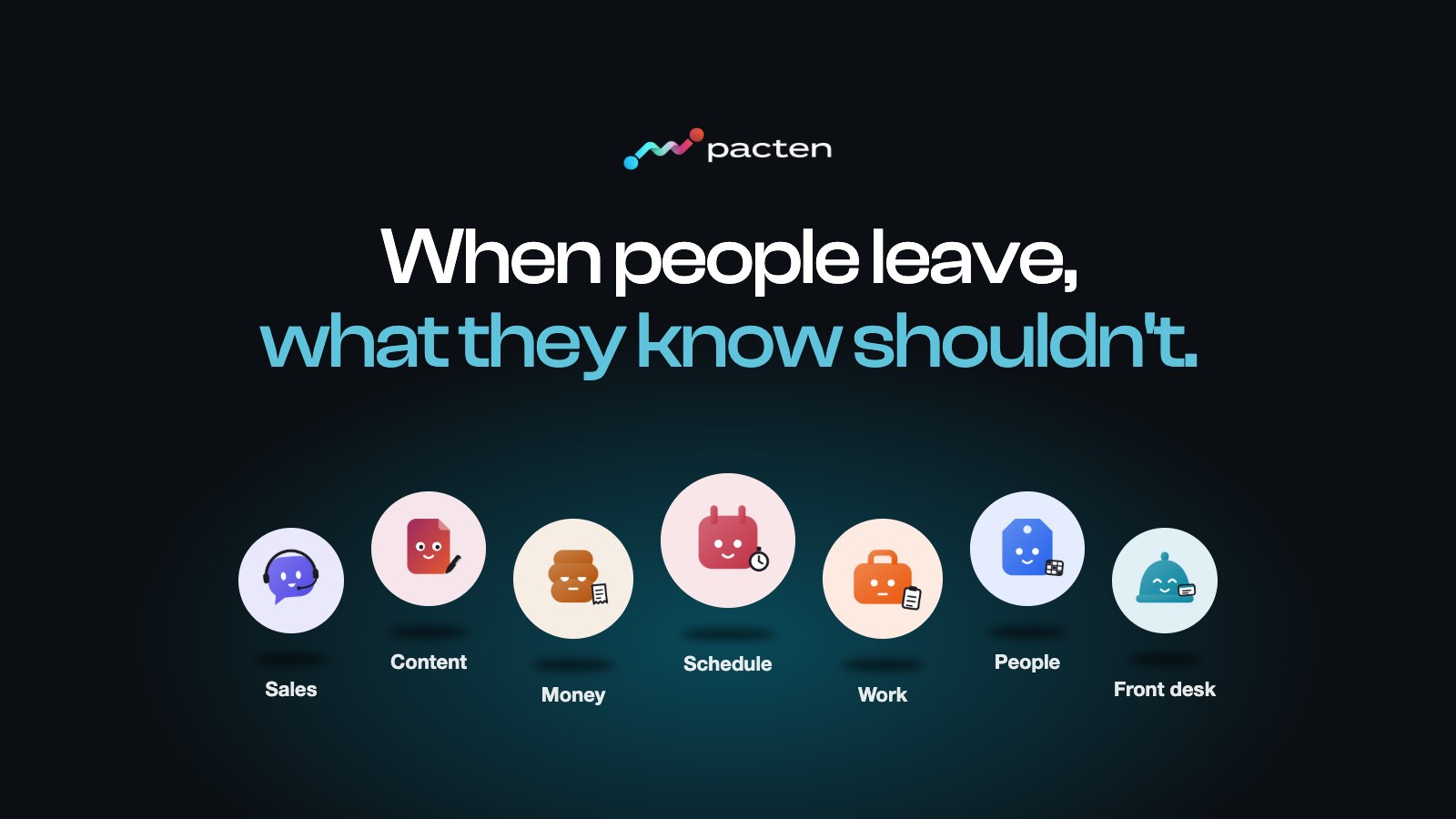
Pacten also uses AI coordinators across areas such as sales, content, money, schedules, work and people. The idea is to prepare routine work around the business rather than simply generate another report about it.
That makes Pacten a useful Zoho Analytics alternative for owners who want AI closer to the everyday records and decisions of the business.
Zoho Analytics vs Pacten: which should you choose?
Choose Zoho Analytics if:
You already have significant data in multiple systems.
You need sophisticated dashboards and reporting.
Your team wants semantic models and data governance.
Forecasting, anomaly detection or machine learning matter to your work.
You have people who are comfortable building and maintaining analytics workflows.
Choose Pacten if:
Your business sells, books, delivers and invoices.
You want those activities connected around the same records.
You are tired of re-entering the same client information.
You want operational questions answered from the records behind them.
You would rather reduce system fragmentation before adding another analytics layer.
For some businesses, the answer will actually be both.
Pacten can become the connected operational workspace while a dedicated analytics platform handles deeper reporting and modelling.
Check Here:
The honest bottom line
Zoho Analytics has made a serious move into agentic analytics.
Its latest platform is built for businesses that want AI agents to prepare data, analyse it, build dashboards and help people move from information to action. Its strengths in modelling, forecasting and governance are real.
But a small business should ask a question before asking what dashboard to build:
How many times does the same information have to be entered before we can understand what happened?
If the answer is “too many,” then a Zoho Analytics alternative may not need to be another analytics platform.
It may need to be a better-connected business record.
Pacten keeps the people, work and financial activity around the same business records, so a question about your numbers can lead back to the clients, bookings and work behind them.
Because the best insight is not always a prettier chart.
Sometimes, it is simply being able to see the whole story.
Frequently asked questions
- Is Pacten a good Zoho Analytics alternative?
- It depends on what you need. If you want one workspace where clients, bookings, contracts, invoices and projects share a record, and AI that answers from it and waits for your yes, Pacten is a good fit. If your main need is deep data modelling and analysis across data that lives in other systems, Zoho Analytics is stronger there and you should probably stay.
- Does Pacten AI change anything on its own?
- No. Pacten AI prepares replies, follow-ups, reminders and drafts, then waits for a person's yes before anything is sent, published, paid or changed. Everything it does is logged.
- Can I use Pacten AI inside Claude or ChatGPT?
- Yes. You connect with a Pacten login and ask about your business there. An owner or admin chooses the level: look only, prepare drafts, or make changes after a yes. Changes only happen once the person confirms inside Pacten.
- Can I keep Zoho Analytics while I try Pacten?
- Nothing stops you. Many teams will want to test Pacten on real work during the free trial before deciding. You can keep your analytics tool for deeper reporting until you know whether the shared record covers what you need.
- How much does Pacten cost?
- Pacten has three plans, Starter, Operator and Platform, and each starts with a free trial. Prices differ by region and are listed on the pricing page.