AI vendor lock-in
AI vendor lock-in is the risk hiding behind a headline about two AI companies joining forces.
When Ada and Dialpad announced their planned combination, the bigger question for small businesses was not which company would come out ahead. It was this: where does your client history live, and can you still reach it if your software changes?
The companies announced the deal on 4 November 2026. The Globe and Mail reported a valuation of about C$600 million, while Dialpad’s official announcement said the financial terms were not disclosed. The transaction is expected to close on or around 12 November 2026, so the companies have agreed to combine but the deal has not yet closed.
See also
What the Ada and Dialpad deal tells us
Ada, founded in Toronto, builds AI agents that handle customer interactions across channels and can complete tasks through connected business systems. Dialpad is known for business communications and contact-centre software, including AI-powered voice and messaging. The companies say the combined platform will bring communications, customer intelligence and AI execution together.
That is a significant move in customer-service technology. It could give customers a more connected experience, with fewer hand-offs between a conversation and the action needed to resolve it.
But a merger also gives customers a sensible reason to review their software arrangements. Products can be combined, renamed or retired. Pricing and plans may change over time. The companies say existing customers will continue on their current contracts, pricing and support arrangements for now; that is useful reassurance, but it does not remove the need to understand your own data arrangements.
And that is where AI vendor lock-in becomes a small-business issue.
Read On:
The real risk is losing the thread of a client relationship

Imagine a customer messages your business to move a Friday appointment. They also ask whether their deposit can be refunded. Your AI assistant handles the conversation, updates a booking and records the refund request.
Now ask: where is that information saved?
If the conversation exists only inside the AI assistant, your booking calendar, invoice record and next support tool may never see it. If you change providers, you could be left rebuilding the customer's history from messages, screenshots and memory.
That is AI vendor lock-in in practice. It is not simply being tied to one chatbot or model. It is becoming dependent on a provider because the context your business needs is trapped inside its product.
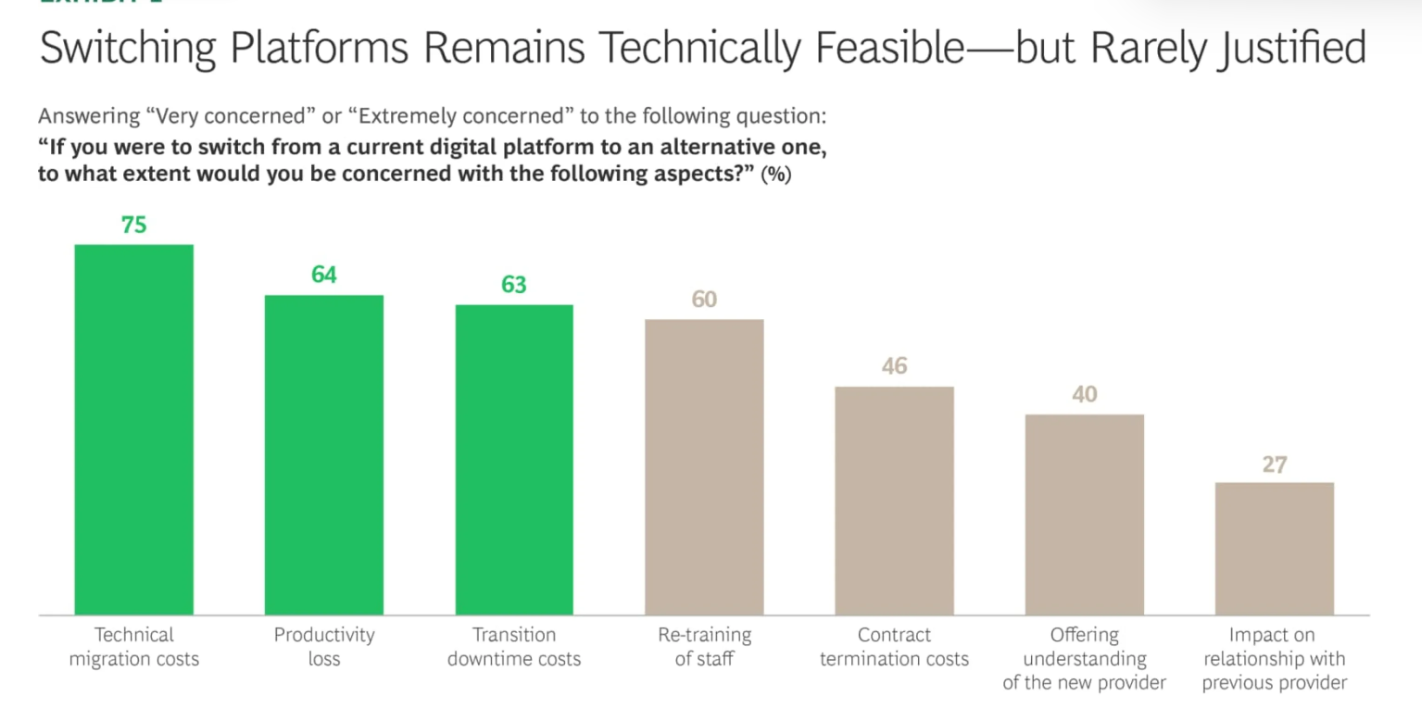
The concern is not theoretical. In a 2025 study of 500 IT decision-makers, Boston Consulting Group found that 62% were concerned about digital-platform lock-in. The same research found that 77% preferred to retain their own data model rather than adopt a platform-native one. These are enterprise-wide findings, not a small-business survey, but they underline why data control deserves attention. The BCG research and its supporting exhibits provide the wider context.
A specialist tool can still be the right choice
Let’s be fair: not every business needs one platform to do everything.
A company handling thousands of calls may need the depth of a specialist contact-centre system. A small consultancy may care more about connecting enquiries, appointments, proposals, contracts, invoices and follow-ups. Those businesses have different operational needs.
The problem is not using specialist software. It is allowing every specialist tool to become the only place where a piece of your client relationship exists.
You can use a dedicated phone platform and still keep the resulting client notes, commitments and follow-up actions attached to a shared customer record. That is a more useful way to think about AI vendor lock-in: choose the tool that does the job well, but do not let it become the only keeper of the information your business needs.
What one shared client record changes
This is the principle behind Pacten. Its CRM, bookings, contracts, projects, invoices and communications work from the same client record. A booking, a signed agreement, a message and a payment are connected to the same relationship instead of being copied into separate systems.
That gives your team continuity. Someone handling a customer today can see what was agreed earlier, what has been booked and whether an invoice is outstanding. The AI team can work from that business context instead of relying on a separate assistant chat to remember the details.
Pacten also connects with tools businesses already use. Teams can connect Claude or ChatGPT to ask questions about their business and prepare actions. Pacten shows a preview before a change is made, and the change happens only after the user confirms it. Slack can be used for alerts and live-chat responses, while the wider integrations include calendars, email, payments and messaging.
For marketing work, Pacten Studio brings campaign and content planning, creation, approval and publishing into the wider workflow. That matters because a lead generated by a campaign should not become disconnected from the client conversation and work that follow.
A shared record can reduce dependence on one AI assistant. But let’s be precise: it does not automatically eliminate platform lock-in. If a platform becomes the only place your business data exists, you still need to understand how to retrieve that data if you leave. That is a question worth asking Pacten and every other provider.
Five questions to ask before choosing an AI vendor
Before you commit, ask:
Can I export my data? Check whether you can retrieve contacts, notes, conversations, bookings, attachments, contracts and invoices, not just a list of names.
What format will I receive? Ask whether the export is usable in common formats and whether IDs, timestamps and relationships between records are preserved.
What happens when I cancel? Confirm how long you can access your data, whether there are export fees and when the provider deletes it.
Can the AI act outside its own tool? Understand which systems it can update, what permissions it needs and whether a person approves important actions.
What changes if the vendor is acquired? Ask how contract terms, pricing, product access, integrations and support could be affected.
These are not awkward questions. They are part of choosing business software responsibly. You should expect clear answers from any provider, including us. Pacten’s pricing page sets out its plans, while the integrations page shows the tools it connects with.
How to reduce AI vendor lock-in without adding more admin
You do not need to predict the next acquisition. Build a few habits that keep your options open.
Keep one dependable client record. Attach key conversations, bookings, agreements, payments and follow-ups to the same client rather than leaving the only copy inside an AI chat.
Test data portability early. Before a long-term commitment, ask for a sample export and check that it is readable and complete. Repeat the check periodically.
Separate the assistant from the source of truth. Treat AI as a way to find information and prepare work, not as the only place where business history lives.
Set approval rules. Let AI draft, recommend and prepare routine actions, but require a person to approve changes that affect money, contracts or important customer commitments.
Review your software stack. Once or twice a year, check what each tool costs, what it stores, which integrations matter and whether you still need it.
The aim is not to avoid every platform relationship. It is to avoid losing control of the information and decisions that make your business work.
Try Pacten
Your AI tools should help your team serve clients, not hold your client history hostage. Pacten brings client records, bookings, contracts, projects, invoices, communications and an AI team into one connected workspace. Explore Pacten and see whether a shared record fits the way your business works.
Learn More:
Frequently asked questions on AI Vendor Lock-In
1. What is AI vendor lock-in?
AI vendor lock-in happens when a business becomes dependent on one provider because its data, workflows, integrations or customer history are difficult to move elsewhere. It can make changing tools expensive or disruptive.
2. Does using an all-in-one platform prevent AI vendor lock-in?
Not automatically. A connected platform can reduce duplicated records and make day-to-day work easier, but it can also become a central dependency. Check its export options, contract terms and data-retention policy before committing.
3. How can a small business avoid AI vendor lock-in?
Keep client history in a dependable business record, test exports, understand permissions and cancellation terms, and avoid making one AI chat the only place important information is stored.
4. Is Pacten a replacement for specialist contact-centre software?
Not necessarily. Businesses with complex, high-volume phone operations may still need a specialist contact-centre platform. Pacten focuses on connecting everyday business operations and client records, and can sit alongside specialist tools where the required integrations are available.
Frequently asked questions
- What is the Ada and Dialpad deal?
- Ada, a Toronto company that makes AI customer service software, is merging with Dialpad, a US software company. The Globe and Mail puts the deal at about $600 million. Sources told the paper it could close as soon as next week.
- Does this merger affect a small business that uses neither product?
- Not directly. It does show that vendors in customer communications are consolidating. That is a good reason to keep your client history on one record you control, so a vendor change elsewhere does not scatter it.
- Can Pacten AI answer customers by itself?
- Pacten AI prepares routine work such as replies, follow-ups, reminders and drafts. It waits for a person's yes before anything is sent, published, paid or changed. Every action is logged.
- Does Pacten work inside Claude and ChatGPT?
- Yes. You connect with a Pacten login and ask about your business there. An owner or admin turns it on and picks the level: look only, prepare drafts, or make changes after a yes. Nothing happens until a person says yes inside Pacten.
- Is Pacten a replacement for a phone contact-centre platform?
- No. Dialpad is stronger in enterprise telephony and contact-centre software. Pacten suits businesses that want clients, bookings, contracts, invoices and projects on one shared record, with an AI team working from it.