AI for small business
AI for small business can give owners hours back, but those hours do not automatically bring in customers. What happens next depends on where that time goes: into stronger client relationships, timely follow-ups and work that can actually generate revenue.
That's the distinction at the centre of a recent Fortune article by Eric Groves, CEO and co-founder of Alignable. His argument challenges the idea that the biggest problem facing small business owners is a lack of time. They may have a different problem entirely: finding their next customer.
See also
What the Fortune story says about AI for small business
Meta, Google, OpenAI and Anthropic are competing to become the assistant small business owners rely on every day. Their tools promise to handle administrative work, answer questions, draft content and automate routine tasks.
Groves welcomes the competition, but argues that it does not address the biggest question keeping business owners awake: where will the next customer come from?
He draws on Alignable's network of small business owners and its relationship data to make his case. According to the article, Alignable members report that approximately 85% of their customers come through referrals rather than advertising, search or cold outreach.
There is an important qualification here. This figure describes Alignable's membership and should not be treated as a universal finding for all small businesses. Groves is also speaking from a position of interest: Alignable operates a business networking platform.
His other observation is that 50 warm relationships can be more valuable than 500 cold contacts. He presents this as a rule of thumb drawn from experience, not a formally measured benchmark.
Still, the argument is worth examining. A business can have excellent software, a productive team and an impressive marketing calendar, yet lose opportunities because nobody follows up with a former customer or maintains a relationship with a valuable referral partner.
Time saved is not revenue earned
The numbers from Bluehost's 2026 State of Small Business AI Confidence study make an interesting case.
The research surveyed 350 small business owners across the United States and found that:
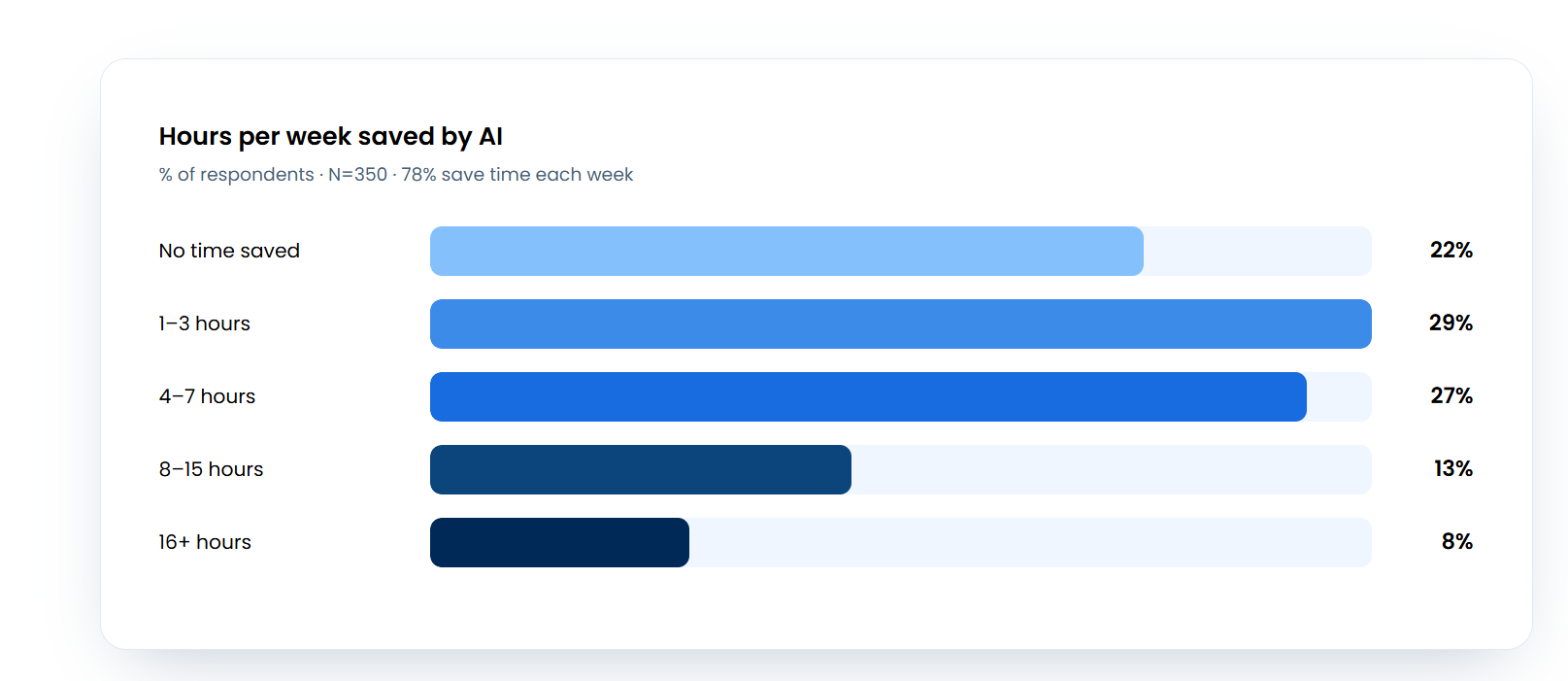
78% said AI saves them time every week.
13% reported saving at least eight hours weekly.
39% of the 299 AI users who answered the revenue question reported some revenue increase.
43% of those respondents reported no change in revenue.
The difference between saving time and generating revenue is difficult to ignore.
The revenue figures are self-reported, so they do not establish that AI caused the increase or that the hours saved were responsible for it. But they do show that productivity improvements and financial results are not the same thing.
You can explore the Bluehost research and its supporting charts, particularly the sections on weekly hours saved, revenue changes and AI confidence.
Here's the takeaway: a business can become more efficient without becoming more profitable.
The solution is not necessarily to add another AI subscription or automate more activities. Sometimes, it is to reconsider what the business does with the time it has recovered.
Read also
Two different jobs, two kinds of AI
It helps to separate the work that saves time from the work that develops customer relationships.
1. The administrative assistant: Getting time back
This is where general-purpose AI assistants are particularly useful.
They can draft customer responses, prepare proposals, summarise meetings, create social posts and organise information. Business owners can also use them to prepare invoices, manage tasks and automate repetitive administrative work.
These are valuable improvements. A business owner spending less time writing routine emails has more time available for other priorities.
But efficiency is only the starting point.
2. The relationship manager: Finding and keeping customers
Customer relationships require a different kind of context.
Who referred your last five customers? Which former client might need your services again? Which partner promised to introduce you to someone? Who has an outstanding proposal waiting for a response?
A general AI assistant can suggest ways to build relationships, but it cannot reliably answer those questions without access to relevant business information.
Groves takes this further. He argues that the most valuable growth opportunities could come from AI that understands connections between different businesses: who knows whom, which businesses serve similar customers and where a useful introduction might exist.
That is a distinct category of AI for small business. It is not simply about managing tasks or answering questions. It is about understanding the relationships that create commercial opportunities.
Where should you spend the hours AI gives back?
The Fortune article recommends identifying the people most likely to send you business and deliberately making time for them.
That is sensible advice. But knowing you should follow up is different from having the information needed to do it well.
Here is a practical way to turn saved hours into relationship-building activities.
1. Identify your most valuable relationships.
Start with ten people. They might include existing customers, former clients, professional contacts, suppliers and businesses that serve the same audience without competing with you.
2. Review your last conversations.
When did you last speak? Was there an outstanding question? Did they mention a project, a challenge or an upcoming business need? Use that context to make your next conversation relevant.
3. Schedule meaningful follow-ups.
Do not send another generic message just because your AI assistant has prepared one. A useful follow-up might reference an earlier conversation, share a relevant resource or check whether a previous requirement has been resolved.
4. Look for opportunities to give value first.
Good business relationships are reciprocal. Introduce people who could benefit from knowing each other, share opportunities and recognise when another business could use your services.
5. Track what happens.
Measure replies, referrals, repeat bookings, qualified leads and actual revenue. Over time, you will see which relationships deserve more attention.
The challenge is often step two. Client conversations, invoices, bookings and contact details are scattered across different systems. Before following up, someone has to piece together what happened.
That is where a connected business workspace becomes useful.
Read On
Where Pacten fits into the AI for small business conversation
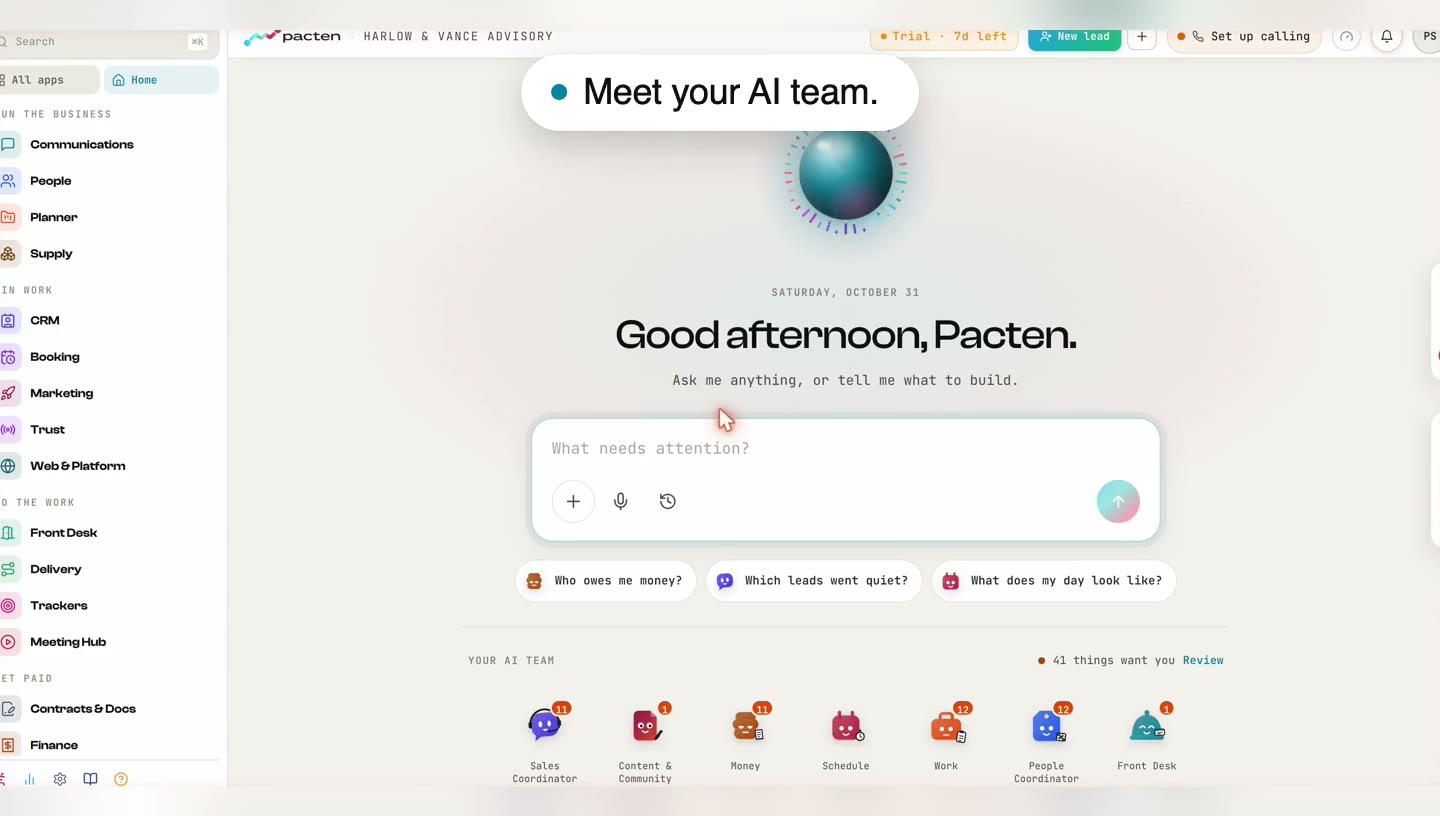
Let's make one distinction clear: Pacten is not a networking platform that maps relationships between independent businesses or identifies people who can introduce you to potential customers.
Its role is different. Pacten helps you organise and manage the relationships your business already has.
Its CRM, bookings, contracts, projects, invoices and communications work from the same client record. A new enquiry, an earlier conversation, a booking and an outstanding invoice remain connected.
That means when you open a client record, you have the context needed to decide what happens next. You are not searching through an inbox, calendar and spreadsheet to reconstruct the relationship.
Pacten Communications brings email, WhatsApp, SMS and calls into one inbox, with conversations associated with the client's record. A discussion with a customer or referral partner can therefore be viewed alongside their previous deals and other relevant activity.
And there is another useful layer.
Pacten AI works where you already ask questions
Pacten AI connects your business records to Claude and ChatGPT. Instead of copying information into an AI conversation, you can ask questions about your actual business.
For example:
Which new leads haven't been contacted?
Which client conversations are waiting for a response?
Who has an outstanding proposal?
Which customers haven't booked again recently?
What follow-ups are due this week?
Pacten AI can also prepare actions, such as adding a lead, drafting an invoice, scheduling a meeting or preparing a marketing post. It shows you what will happen before you approve the change.
This is where AI for small business becomes more useful operationally. Your assistant is no longer working from disconnected prompts alone. It can work with the business records that provide the context behind your decisions.
For marketing, Pacten Studio adds another dimension, helping businesses plan, create, approve and publish campaigns and content from the same wider workspace.
You can explore Pacten's features, see its AI integrations and read the Claude and ChatGPT setup guide.
A better way to measure the value of AI
The competition between major AI companies will continue, and small businesses should benefit from the improvements.
But evaluating AI for small business purely by the number of hours saved misses an important part of the picture.
Ask what those hours are making possible.
Are you following up with customers more consistently? Are you revisiting old proposals? Are you building relationships with potential referral partners? Are you converting more qualified enquiries into paying clients?
An assistant that saves three hours a week is useful. An assistant that helps you use those three hours to strengthen customer relationships could contribute to something even more valuable.
The objective is not to automate every interaction. It is to make more room for the conversations, decisions and relationships that help a business grow.
Continue Reading
Frequently asked questions for AI for Small Business
Can AI help a small business get more customers?
Yes, AI can support customer acquisition through marketing content, lead research, customer communication and follow-up preparation. However, it does not guarantee new customers. Results depend on the quality of the offer, customer relationships, targeting and how consistently opportunities are followed up.
What is the difference between an AI assistant and AI business software?
An AI assistant generally helps with tasks such as writing, research, summarisation and answering questions. AI business software connects those capabilities to operational information such as customers, bookings, invoices and projects, allowing the business to work with its actual records.
How can small businesses use AI to improve customer relationships?
Businesses can use AI to review customer history, identify overdue follow-ups, summarise previous conversations and prepare personalised messages. Human judgement remains important because genuine relationships require context, relevance and trust.
Does Pacten help businesses find referral partners?
Pacten does not map external business networks or identify referral introductions. It helps businesses manage their own leads, clients, conversations and follow-ups through connected records, making it easier to maintain existing customer and professional relationships.
Put your recovered time to better use with Pacten
AI can take repetitive administration off your plate. What you do with that time is what matters.
Pacten brings your client relationships, communications, bookings, projects, invoices and AI team into one connected workspace, helping you spend less time searching for information and more time acting on the opportunities in front of you.
Explore Pacten and see how a more connected way of running your business can support the relationships that drive it.
Frequently asked questions
- Will AI assistants help me get more customers?
- They will help with the time spent on admin, and that is real. The story argues that finding customers depends on knowing the people around you, which a general assistant does not see. Use the hours it saves on that work.
- Does Pacten find new customers for me?
- No. Pacten does not find customers or map relationships between businesses. It keeps your clients, deals, bookings, messages and invoices on one record, so you can follow up with the people who already matter to your revenue.
- Can I use Pacten AI inside Claude or ChatGPT?
- Yes. You connect with a Pacten login and ask about your business there. An owner or admin chooses how much it may do, and nothing is changed until you approve it inside Pacten. Every change is logged.
- How should I decide where saved time goes?
- Pick the work that earns money before you start. List the people most likely to send you business, check your history with each, and put the follow-ups on the calendar. Then review in a month what turned into work.
- Is the Fortune article independent?
- It is an opinion piece by the CEO of Alignable, who discloses his company's stake. It is worth reading for the argument, and worth checking against what you see in your own business.